
The Greenland Whaling Industry
The North WaterThe voyage’s shrinking commercial prospects expose how industrial change and resource depletion shape the crew’s fate.
increasing Bearing strength in each event
 decreasing
Bearing strength in each eventdecreasingOld Profits Remembered
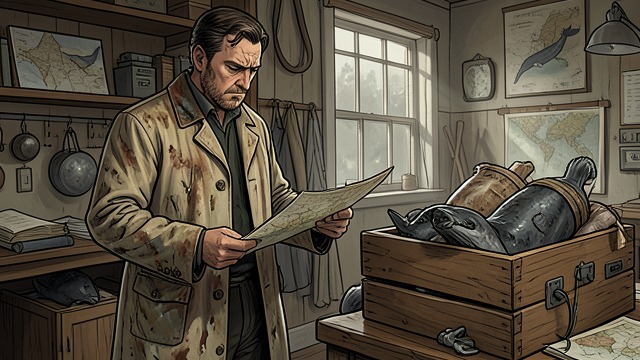
The Trade Has Changed
A former golden age
Jacob Baxter recalls years when ships could return quickly with valuable whale products. Those earlier successes make Arthur Brownlee’s confidence understandable but increasingly anachronistic.
Steam power and harpoon guns now raise the costs of competition.
A market turning away
Petroleum and coal gas are taking customers from whale oil. Baxter sees the trade declining, while Brownlee argues that the whales remain available farther north.
The Northward Pursuit
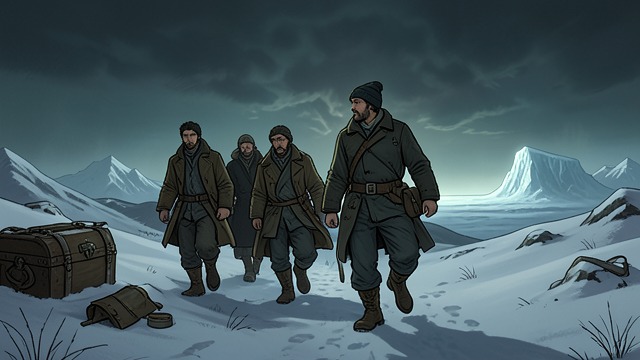
Following the Whales
Risk as strategy
Brownlee takes the Volunteer north, convinced that whales have retreated toward dangerous ice rather than disappeared.
The crew’s route reflects an industry willing to increase danger in pursuit of diminishing returns.
The uncertain ocean
Sumner imagines an immense refuge beyond the ice, while Brownlee treats the same idea as a practical hunting theory. Neither can prove that the hoped-for abundance exists.
A Catch Against the Odds
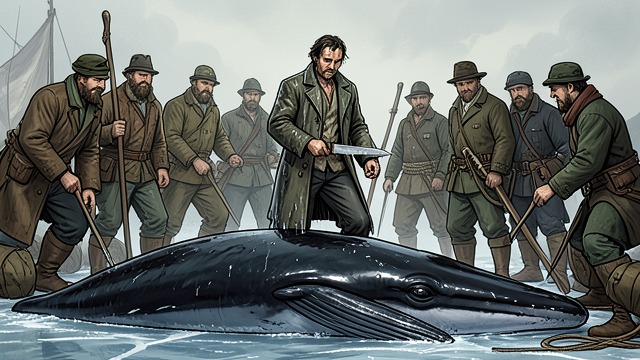
Whaling Still Pays
The whale is taken
The first successful whale hunt gives Brownlee evidence that the voyage may still earn a substantial return. Blubber and baleen are converted into a projected market value.
For the crew, the kill brings a temporary sense of shared purpose.
A temporary reprieve
The catch does not reverse declining markets or restore earlier abundance. It only makes the dangerous venture seem briefly vindicated.
The Dead Whale
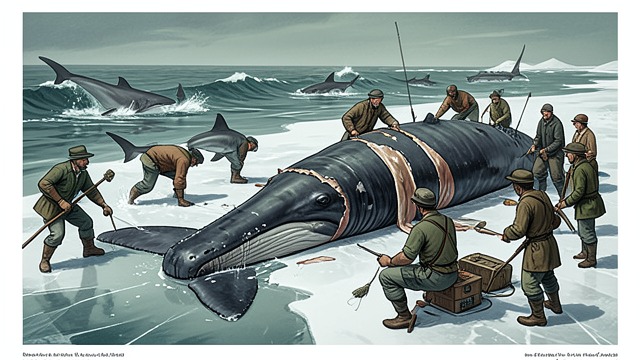
Profit from Decay
A carcass found
The crew finds a whale already dead and bloating. Cavendish orders it flensed despite the rot, because usable blubber still represents money.
The work exposes the bodily cost behind the trade’s market calculations.
Waste becomes product
The carcass is divided into oil and baleen while sharks feed around it. The scene makes visible a commercial logic that extracts value even from decay.
A Trade’s Last Voyage
The Whaling World Ends
The voyage’s costs
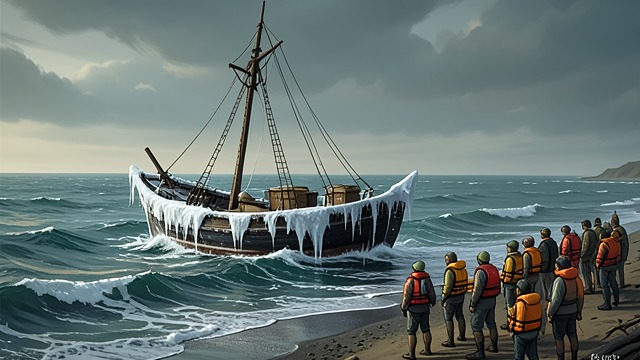
The Volunteer and the Hastings are lost, and most of their crews never return. The disaster magnifies the risks of a trade already losing its economic rationale.
Capital moves on
Jacob Baxter shifts toward paraffin and coal oil after collecting insurance. The men’s deaths mark the end of one business for him, not the end of profit-seeking.
Before departure from Hull
On the passage from Lerwick
At the start of the North Water season
After entering Lancaster Sound
After the survivors return to Hull
